//// RESIDENCY
Written by KEVIN MURPHY ©
____The Public Space and Rhetoric
// SCREENINGS
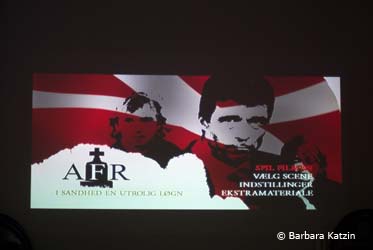
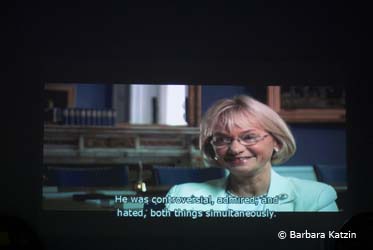
The reading group discussion concluded with a private screening of AFR by Morten Hartz Kaplers. Combining archival footage and fictional scenes with actors, the mockumentary treads in a contentious space between actuality and fantasy, reportage and representation, and historical fact and sensationalist tabloid human-interest fiction. It sparked a conversation about the public image versus private lives of professional politicians, the role of the media in producing such 'infotainment', and questions of identity and rhetoric in the production of successful political icons.
And to wrap, the outdoor film screening was a total blast! The group assembled at rum46. Along with some members of rum46, I took a taxi loaded with white paint, rollers, projection and sound equipment, a generator, a pot of soup, warm drinks, beer, plastic-bucket-seats, warm clothes, lots of other stuff, and a hunger for the moving image. The rest of the group went on foot through the city to the screening location along the outside wall of the abandoned Godsbane, the city's old freight yard. For years, Godsbanen has been the undeveloped site of the city's plan for a production center for stage arts, visual arts, and literature and the urban renewal of the adjoining rail areas.
Entitled Streethearts, the mobile cinema program presented films addressing the recent waves of privatization and gentrification of public urban space in Copenhagen and the actions of artists, activists, and sub-cultural communities in resistance.
We had lots of fun that night and accidentally got white paint on our jackets and on the seats of the taxi home. The taxi driver was pissed off, so we cleaned his upholstery with soapy cloths. That night marked the final public event of my residency.
With one week left in Århus, I decided to turn to personal production and use rum46 as a studio to test-drive some drawing experiments and an aborted video idea in public space. I also found time to enjoy the city's nightlife, danced to some local dj’s and live Danish pop acts, attended the opening of Jeppe Hein’s show at ARoS, found a lover, met a shepherd who writes folk music and does children’s theatre and swims in the sea every morning of the year, saw a 2000-year-old peat-bog-preserved corpse at Moesgård Museum, thought about human sacrifice, cooked, watched TV, and drank the local beers.
// FURTHER INFORMATION
___on the Godsbanen project:
http://www.godsbanen.dk/english
http://www.23hq.com/gydum___about the films screened:
CPH Remix
(Director: Ulrik Gutkin, Rúnar J. Gudnason, 59 minutes, Denmark, 2005)
CPH Remix is shot during the biggest 'fairytale' event during the last four decades in Denmark: The royal wedding between Crown Prince Frederik and his Australian fiancée, Mary Donaldson. While the city is dressing up for the royal event, two local artists are working intensely in the streets with their arts. Meanwhile a desperate graffiti remover from the city council is trying to clean up the 'mess' before the giant event. The film follows the two artists in their work and gets close to the human need to express itself. It's a need that even the graffiti remover has to acknowledge in the end of the film. Through the two artists' work… we sense the organism of a big modern city in Europe.69
(Director: Nikolaj Viborg, 59 minutes, Denmark, 2008)
69 tells the story of the Youth House and the community supporting it, before the building was torn down, told by the youths themselves. We are shown images from the many meetings and preparations on the roof of the building, and we are there during the violent moments when the police storm the building. The film portrays the final six months of the Youth House's 25-year history as a refuge for youths, but also shows the move from Jagtvej 69 to the new house on Dortheavej. 69 is more relevant today than ever before: the youths may well have been given a new house, but the legal proceedings have just started.
The sale and demolition of the Youth House, the normalization of Christiania, the restoration and demolition of A-huset and the silo on Island's Brygge, the sale of property on the waterfront: the unconventional and quirky city projects are driven further out into the city's peripheries. There are less and less sanctuaries for artists, punks, hippies and other people who don't want a beautification of the city. Has Copenhagen become less diverse? Should the nature of diversity be determined by the elites or by the masses? Does the urban space belong to the citizens or has it come to belong to politicians?(from CPH:DOX catalog)
Read more here.
// INTRO_TALK