//// RESIDENCY
Written by KEVIN MURPHY ©
____The Public Space and Rhetoric
I intended the reading group meeting to serve as a forum for the public to come together and interrogate the topic from theoretical, historical, and anecdotal points-of-view. In speed-reading on the topic to select a text, I spent much of August in Copenhagen familiarizing myself with the writings of Jürgen Habermas and Hannah Arendt on the emergence and transformations of the public sphere in Western democratic contexts. It was striking for me to note the two theorists' profound distrust of modern technology and mass media. Habermas, in particular, argues that the emergence of a liberal society of advertising, entertainment, and mass-mediated consumption short-circuited communication between citizens, thereby supplanting their physical presence in public urban space, disrupting their engagement with local issues, and derailing the practice of political organization. However, in describing historical moments and spaces conducive to the emergence of the public sphere, both Habermas and Arendt seem to suggest complex understandings of spatiality as not purely physical. As an MFA student at Malmö Art Academy, I remember my advisor suggesting that I do some reading on the terms and conceptions of 'space' and 'sites'.
At the time I did not delve deeply into the material, but three years later, one month before the start of the residency, I recognized the opportunity to revisit my old unfinished homework. I turned to Henri Lefebvre and Michel de Certeau's ideas that liberate space from the 3-dimensional Cartesian grid, ascribing it also to mental, social, lived, virtual, representational and discursive dimensions. As a text for the reading group, I decided on a chapter from Diana Saco's Cybering Democracy, which departs from theories of embodiment and spatiality and notions of democratic utopias to examine recent debates around the internet as a space that furnishes sometimes contradictory potentials for the practice of democratic deliberation.
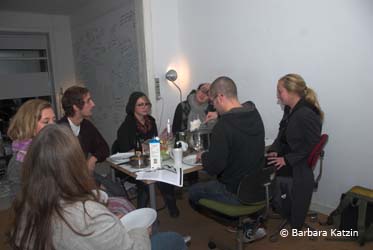
We met over drinks and a nice dinner prepared by rum46. The reading group moved fluidly over the terms of the discussion. The participants illustrated their personal understandings of space through anecdotes and shared mental mapping. I recall the conversation touching upon:
The spatial theories of Foucault, Lefebvre and De Certeau
Collapsed notions of geographic space in local/national/global communities in the internet age
The role of the body in debates of democratic participation and deliberation, both in physical social space and virtual meeting points
Disaffected youth and nihilism
The ideological role and effects of education
Public assertions by Dansk Folkeparti's Morten Messerschmidt human activity should not be the focus of the global warming debate
The rhetorical responsibilities of politicians and public servants
The representational strategies and ideological effects of public versus private media outlets
Rum46's practice of serving dinner at its public events
The spatial practice of the dinner in its construction of community
Franklin D. Roosevelt's New Deal socialism
Obama’s push for an expanded public ("the public option")
The Nazi's use of language in the legal institution of terror and mass-murder
Organized crime
Cults
The Manson Family
Torture and war
Guatanamo
Borge's Chinese encyclopedia
Foucault’s laughter
The Danish Mohammed drawings
Foucauldian heterotopias
Cruise ships, airports, boarding schools
The mirror
Quantum physics and unperceivable spatial dimensions
Conventional cinematic coding and experimental film
Stan Brakhage and contemporary music videosRead more here.
// INTRO_TALK
// SCREENINGS.