//// RESIDENCY
Written by KEVIN MURPHY ©
KEVIN MURPHY
// about
Kevin Murphy is a US-born artist and media arts curator living between Berlin, Copenhagen, and Fritsla, Sweden. He presented the solo exhibition Soft & Hard at rum46 in June, 2009 and returned to rum46 as artist-in-residence on the topic Public Space and Rhetoric for 3 weeks in September-October, 2009.
// projects
// PREFACE__June 11, 2009, 19:45
I nervously pound a beer in the rum46 office rehearsing my solo interpretation of Tina Turner’s Private Dancer. I wrap multi-colored bed-sheets around my body, cloak my head in a pillow-case, and am led by a friend out to my installation for the live performance. The video component of the installation presents webcam views of boys flirting, strip-teasing, sleeping, dancing, speaking to whoever is watching, and cyber-chatting in interiors that resemble everything from typical bedrooms to kitschy porn-film sets to booths in sex-work 'call-centers'. An exhibitionistic Cuban-American flexes and flashes his cock at anonymous viewers, hoping to coax a member of the website into a lucrative, 'private' (ie: one on one) webcam viewing session. Cut to the Romanian 19-year-old in what appears to be a vintage-clothing shop changing room cubicle with 'walls' of hanging bed-sheets. He looks pasty and bored under the fluorescent drop-ceiling lighting as he mechanically licks his lips, signalling the clichéd sign of horniness, but there is no wild flash in his eye—another day at the office. We hear him conversing through the fabric wall with the female voice in the adjoining cubicle. They sound familiar to one another, fed-up, ready to make a break for it. I climb onto the installation and, mirroring the projection, I pose, flex, and bump and grind slowly and deliberately for the public.
____The Public Space and Rhetoric
// INTRODUCTORY TALK__September 24, 2009, 18:45
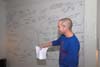
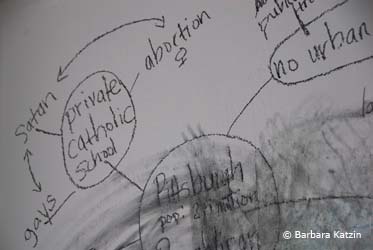
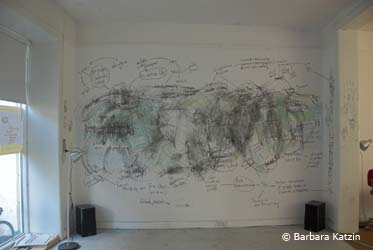
I find myself back in the rum46 office, anxiously necking another beer. I skim my notes and prepare to deliver my introductory talk in the gallery, announcing a structure for my time in Århus and the public offerings I have planned for the residency. This time I show my face and refer to a crude 'mind-map' sketched on the wall in black charcoal. The map depicts a rendering of the path I recall travelling on my journey from childhood in Pittsburgh, through my mid-20s professional life in New York City, and onward to my MFA studies and experience with the public social and cultural institutions of Scandinavia. Through an annotated personal narrative, I sought to illustrate the development of my understanding of notions of 'the public'—beginning with the very narrow and unprivileged position of the public sphere in US institutional orders (and the cultural identities engendered within this marginalization), through my experience of the more developed historical/cultural notions and institutions of 'the public' across the Scandinavian welfare states. After 8 years of a Venstre/Konservativ/DF coalition, the Danish political and cultural landscape seems a particularly contentious battleground between public and private interests, marked since the 80s by increasingly Americanized social, cultural, and economic ideologies, as well as by discussions of the crisis of the welfare state and Danish national identity.
Applying for the residency, I found myself wondering how to practically approach and hem in a topic as broad as Public Space and Rhetoric.
Having already shown my work at rum46, I decided to forego production/exhibition and focus more on interfacing with the artist and activist communities of Århus, addressing the terms of the topic (ie: 'public', 'space', 'rhetoric') directly and applying their relevance to recent Danish political, social, and cultural debates. I imagined my role during the residency not solely in terms of visiting artist or curator or moderator, but rather as something like conversationalist, addressing the participants at the events in a non-institutional and non-hierarchical way. Illustrating my thinking before arriving in Århus, the following text is lifted from my application and was redelivered in the press release announcing the introductory meeting that kicked off my residency:
A discussion of "public space and rhetoric" in present-day Denmark will provoke an examination of the political, economic, social, and cultural shifts that have rocked Denmark since the late 80s. The Welfare State has been declared to be in crisis and increasing privatization is changing the costs and delivery of social services (Venstre, cuts in education, arts, and public health funding). The widening cultural gulf between 'Danes' and ethnic minorities in Denmark is fueled by the inflammatory anti-immigrant rhetoric and legislation of Dansk Folkeparti, in powerful coalition with Venstre ("Gi’ os Danmark tilbage"). The Ungdomshuset incident and the growing threat to dismantle Christiania have demonstrated the government’s complicity with the private sector in development ventures that threaten cultural institutions and non-mainstream communities and spaces ("Normalisere Christiania"). The aggressive police presence in opposition to leftist street culture, immigrant groups, the marijuana/hash trade, and protest movements in Copenhagen has further aggravated tensions between the state and the individual, social order and 'freedom', the businessman and the socialist and human rights activist. Traditional and historical notions of janteloven are embattled by new globalized generations and in youth and queer subcultures (the "Janteloven, hvorfor?!" club on www.boyfriend.dk). On these and many other fronts, the public domain is marked by ethical and political debates over rhetoric and what it means to define and articulate "Danishness". In addition to the above political and cultural topics, discussions will address theoretical questions such as theories of spatiality in relation to physical and urban space as well as to language and discourse, the public, and cyberspace and virtual worlds.
Having spent several summers in Copenhagen, living in Nørrebro and working in Christiania, I have followed first-hand the above-cited political events and debates. From a US American perspective, I have felt generally refreshed at the level of active organization, engagement, and dialogue between Copenhageners of all political persuasions. Accustomed to the feeling of not being represented within the mess of the two-party US 'democratic' system, and frustrated by feelings of political futility and apathy, I am refreshed by the relative accessibility and specificity of Danish politics. With more parties bringing local and niche issues to national attention, broader representation of the political spectrum in Christiansborg through shuffling coalition partnerships, and a relatively greater degree of transparency and visibility in reporting political debates (as abetted by the prominence of Danish public media outlets), Danish democracy wowed me and rekindled my inclination to local political awareness and action.
With my enthusiasm to activate discussions on national political issues, I proposed a tripartite structure for my interface with the public that included on-site studio visits with local artists, a screening program to take place outdoors in public space, and a reading group that would meet once over dinner in rum46. I received an enthusiastic response from a diverse swatch of local artists who signed up for studio visits. I met twice with a group of students from Det Jyske Kunstakademi who were invited to participate in the rum46-organized group exhibition entitled Direct Democracy, to be mounted in public space in Århus in November, concurrent with the Danish regional elections. As a group we examined the context of the show, the politics and production methods of rum46, local precedents and possible sites of public exhibition, and questions of audience, media and content. Each artist also presented his/her own project ideas, interrogated and developed over the two-week meeting plan. I also had the opportunity to meet with the students of Ditte Lyngkær Pedersen's class at Århus Kunstakademi, who presented their artworks for their group exhibition in the smoking lounge in a local club. I, in turn, gave a presentation of my own recent work, which opened up a sense of reciprocity, familiarity, and casualness in our meetings over the 3-week residency period. In addition, several professional artists showed me their work, introduced me to sites of cultural production around town, and gave me a better idea of how it is to live and work as an artist in Århus. Ultimately these meetings allowed me to develop more complex personal and professional relationships to the city and its artists. I no longer felt like a lost tourist in Århus; I had found a network.
Read more here.
// SCREENINGS