//////// RESIDENCY
___Finders Keepers by Jeuno Je Kim©
w/ Screening of Janitor_a video by an anonymous itinerant Han folk artist // Script for a Performative Lecture to be read after a screening of Janitor, a 24mins video about Janitors in South Korea.
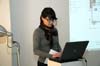
Performer/Reader: Preferably a woman of East Asian descent but not restricted to such.
Costume: Preferably an attire in gray, modest and in line with what traditional professorial types would wear to a conference
Setting: A lecture hall or room—to take place in any city where the lecture can take place without a simultaneous interpreter. Should the context require one, please contact the writer. The script can be re-edited to facilitate onsite translations.It is a great pleasure to be here with you today. I would like to extend a special thanks to rum46 for the opportunity to imagine, a screening of this never-been-seen before video document, and allowing me to involve you in the masquerade of anthropological fictions, ironies and fantastic scenarios that can draw us out and bring us closer to ourselves.
The film we have just watched is a restored digital copy of old video-tapes that I found in the abandoned archives of a Chinese-Korean school in Twomen. We had to carefully clean and retrieve pieces of the tape since much of the film was damaged due to years of moldy neglect having been stored in a damp bunker underneath the school. The school itself is an enclave where ten local teachers share a group of 80 students between the ages of 6-17 giving basic education in Chinese, Korean, Russian, Japanese, Mongolian, arithmetic, history, brail, and agriculture. Although it doesn‘t advertise itself as such, the school has a long legacy of educating those with visual impairments.
I first visited Twomen, a town in the Yanbian Ethnic Korean Autonomous Prefecture in the Chinese Jilin province, in order to study the craniofacial morphology of caecigenus Han tribe Mongoloids.
Historically they had practiced a particular form of radical, or more accurately, a miraculous pedagogy, where children born with high levels of caecum were brought to vision by others living under the same condition of blindness. Now, you are probably wondering where on earth this place is and what relation a study of this barely existent area in the world populated by citizens with what we call visual impairments could possibly have with you.
But before I continue any further with what linguistic anthropologists can drone on about, let me bring you official greetings from my students and colleagues at the University of Barbaria, a venerable institution created under the motto of Virtus, Veritas, Integratus, and Globus: collecting virtuous local knowledge within the Twomen River delta, and truthfully broadcasting this back into the rest of the world for a genuine integration of Asiatic peoples as leaders within the globalized globe. They send warm and special greetings to inform you that although you may not see them, they see you, quite clearly and know your secrets and desires from reading the items you have jettisoned, whose labels and packaging contain in depth messages about consumption and desire. They‘ve memorized, categorized and idolized your garbage which is recycled as wallpaper, clothing, construction material, and household/urban decoration—hence, furnishing the everyday domestic and public landscapes.
In this lecture I will lay down the mental bridge between Twomen River Delta and BERLIN by going through 4 basic posts. First a reading of this video document, a work by an anonymous Han folk artist from the Yanbian area; second, an introduction to what we linguistic anthropologists call “caecitatis linguistics”, a form of ignorant language development that began early in the 19th century; third, a presentation of ignorantem pedagogy, a new foundation for knowledge production based on being stupefied; and finally a commentary on the changing faces of anthropological pedagogy and a call to resistance against the computerized bardus pedagogues that have upheld the axis of inequality.
I hope to contribute to development, not only within this specific geopolitical region, but also to our understanding of subjectivity and how knowledge is held back, suppressed and misused as tools for domination. But before I do that, I want to ask a question: if you were to draw the atlas from memory how many nations and communities can you identify and place “accurately“ in context to each other? Are there blank or foggy spots in your mind‘s globe? If so, which regions do not exist as “places“ in your mental landscape? I think it‘s important to think about individual blind spots and how back and rearview mirrors in our motors can be readjusted to see them.Now, You may ask, what is a foreign anthropology professor doing representing a group of people she obviously does not descend from – and while that is a valid question, I can justify my position of re-representation by stating that the locals have accepted me as one of them. There are many “me“s. When I stand to lecture in Seoul National University, I am a Soul; in Columbia University, I am a Columbian; in University of Barbaria I am a Barbarian, and in Malmö Academy, I am a mammalian. Therefore, when I leave Malmö Academy and go to the University of Barbaria I leave my mammalian self behind and become a Barbarian. My ability to have many mini-me‘s has been recognized by the local elders in Twomen, and they, seeing the economic benefits of this have anointed me to act as their international spokesperson, advertising University of Barbaria far and wide.